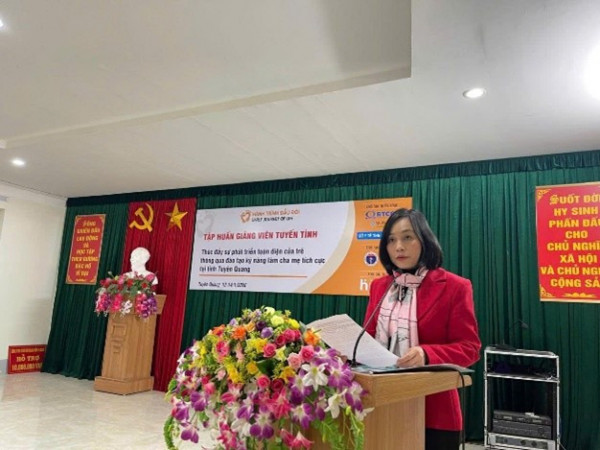
Within the framework of the programme “Promoting the holistic development of children through training in positive parenting skills in five provinces and cities of Vietnam” (EM-THRIVE) [1], the Research and Training Centre for Community Development (RTCCD), in collaboration with the Tuyen Quang Provincial Department of Health, organized a training course for 22 provincial-level trainers, who are officials from the Department of Health, obstetrics and pediatrics doctors from the provincial hospital, the Center for Disease Control, and doctors and staff from regional hospitals and health centers.
Senior Physician, Specialist Level II Do Thi My, Deputy Director of the Department of Health, attended and officially opened the training course. The Department of Health noted that child health care is the result of the combined influence of social relationships. The programme’s interventions for the holistic development of children are aligned with Government Resolution No. 72/NQ/TW, focusing on preventive care and the development of grassroots health services, proactively delivering services to families. The Tuyen Quang Department of Health coordinated from the planning stage, selected local areas for video recording within communities, and piloted implementation among ethnic minority populations prior to the training course.
 [2]
[2]
The training course focused on teaching skills across five domains under the World Health Organization’s Nurturing Care Framework, including health, nutrition, early learning, safety and security, and responsive caregiving. Teaching methods included role-play, guidance on teaching groups of health workers, and guidance on delivering sessions to caregivers during immunization sessions or thematic activities at hospitals.
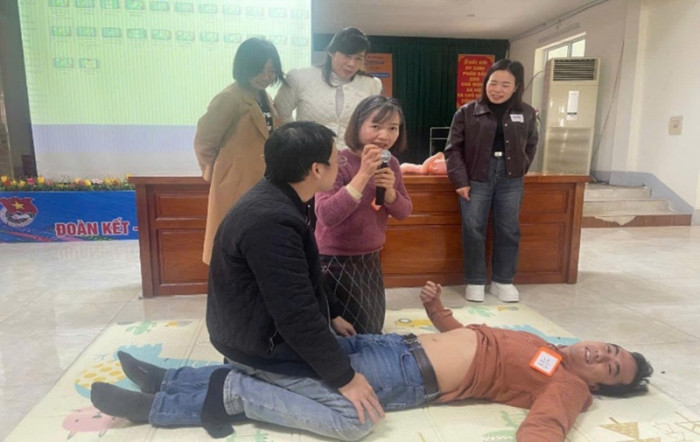 [3]
[3](Trainees practicing first aid for drowning victims)
Specialist Level I Physician Sung Mi Giang from Dong Van General Hospital stated that the video contents were very engaging and meaningful, and that the Hmong translations and voice-overs helped community members and health workers communicate more easily.
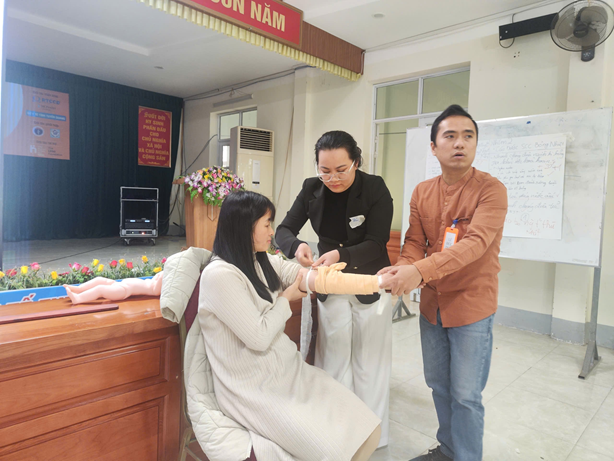 [4]
[4](First aid instruction for a bleeding forearm wound)
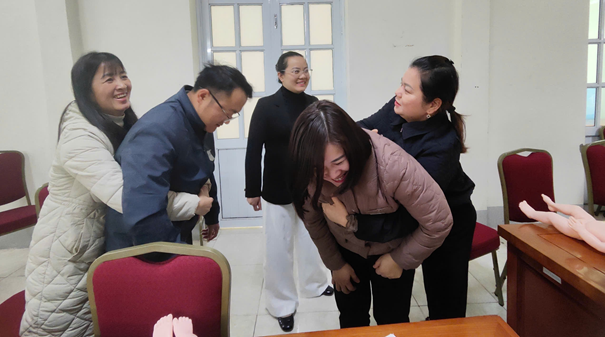 [5]
[5](Trainees practicing how to guide families in providing first aid for choking)
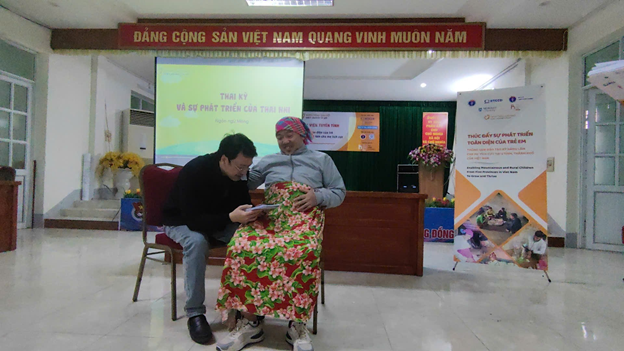 [6]
[6](Role-playing a husband being guided to read stories to his pregnant wife)v
Ms. Nguyen Thi Thuy from Yen Minh Regional Health Center shared: “The course content is very good, covering interventions across multiple areas, and provides ready-to-use tools for health workers to practise. For first-aid techniques, trainees were able to apply the skills continuously across different stages, ensuring continuity from first aid through to when the child shows signs of regaining consciousness and passes the critical stage.”
Immediately after the training course, the Department of Health arranged two additional training courses for commune/ward health workers at 20 commune health stations at the Meo Vac and Quan Ba Health Centers. With in-depth teaching skills and experience working with the Hmong community, Tuyen Quang Province is confident that the programme activities will be implemented effectively, enhancing the skills of future child caregivers.